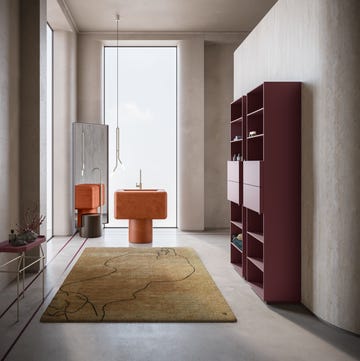
What we value in our homes has shifted significantly in recent years. The changes that were set in motion by the Covid pandemic are still shaping the world of interior design, and one of the biggest growing trends is for at-home wellness. People looking for more than a moment of meditation are dedicating space to saunas and steam rooms.
In some examples, the likes of infrared therapy (lauded for reducing inflammation and easing muscle strain) and, in extreme cases, even hyperbaric chambers (which force more oxygen into the bloodstream) and ice baths are making their way into domestic settings.

‘This isn’t simply about luxury or self-care trends,’ says Amanda Talbot, founder of Studio Snoop, a leader in wellness architecture. ‘We’re seeing a growing awareness that modern life places an unprecedented load on the human nervous system: constant stimulation, digital exposure, poor sleep, chronic stress. People are starting to realise that their homes are either amplifying that stress or helping to repair it.’
That’s the professional and personal journey that Paul Crow, managing director of bathroom brand Ripples, has been on. ‘The older you get, the more you start to realise your runway is getting a bit shorter, and therefore it’s about thinking what you could do to extend it,’ he explains of his decision to learn more about the reported health benefits of sauna and steam, which range from stress relief and workout recovery to skin detoxification, and improved circulation that can aid cardiovascular health and even produce positive effects on mood and sleep.

Ripples sold its first sauna in 2024 and is now working with Italian brand Novellini, which started out selling ultra-high-end saunas but is now utilising trickle-down technology to create models that fit easily into more conventional homes. Crow is evangelical about the possibilities when it comes to wellness in the home, and he is not alone.
CP Hart’s director of design Yousef Mansuri points to solutions such as Effe’s ‘Inside’ steam generator, so compact it can be fitted into a 100mm wall cavity. ‘Technology has come such a long way in the past 10 years, and what used to be only for the very wealthy is now more affordable,’ says Jo Wilkinson, design lead at West One Bathrooms. She is working on a terraced house in Wandsworth, London, that is having a sauna and steam room fitted into the loft.
What's everyone reading?
So, if wellness at home is increasingly accessible, how should it look?

For some, the aesthetic of the hotel spa still reigns supreme. ‘Wellness has always been associated with calmness and a kind of Zen feeling. Historically, luxury hotels really set the tone for this: warm materials, wood, metal, soft lighting, dim atmospheres. Everything is about softness and relaxation,’ says interior designer Dieter Vander Velpen. For a recent project in Bel Air he stuck to these essentials, but added a note of individuality, with a steam room clad entirely in Patagonia stone. ‘It has a cave-like atmosphere – immersive, almost sculptural,’ he explains. ‘The goal is to create somewhere that you can forget about time and place; where you step away from daily reality.’
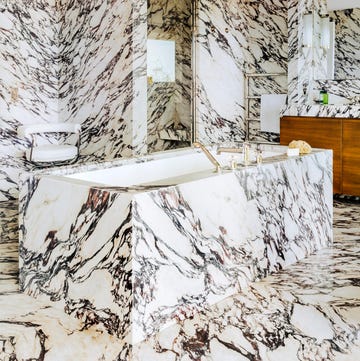
An altogether different type of spa was the inspiration for American interior designer Nannette Brown when working on an extremely luxurious family home in the old Bunny Rockefeller estate in Connecticut (see opening picture). Influenced by clients who were deeply committed to wellness, she looked to combine the crisp, white style of the local architecture with the ‘discipline and austerity’ reminiscent of Alpine health institutes – as she puts it: ‘part German Kurhaus, part Austrian Badehaus’.

Traditional spa style is not the only approach, though. As Studio Snoop’s Talbot points out: ‘Calm doesn’t look the same for everyone.’ ‘Wellness spaces are becoming more sensory, emotional and personal,’ she continues. ‘There’s greater use of colour, tactility, softness and form – elements that engage the body rather than impress the eye. Materials are being chosen not just for durability or luxury, but for how they feel: acoustically, thermally, visually.’ For a recent project, the team at Studio Snoop chose not to default to the familiar language of timber and stone, but instead to focus on ‘curvature, enclosure and tonal gradation, which the body instinctively reads as safer and more regulating’.
Equally revolutionary is Finnish designer Laura Seppänen’s spa, realised for the future-trends exhibition at the country’s Habitare design fair. She agrees that, although traditional Finnish saunas are made from local wood, ‘other materials are sneaking in, such as ceramics, microcement and glass’. Born and raised in ‘the land of a million saunas’, she is perfectly placed with the knowledge to enable her to push expectations, creating innovative aesthetic elements. For this project, her sauna’s doors feature delicate Dedar fabric sandwiched between the glass to add texture and interest, while glass blocks (used to create a floating step up to the timber seating) add an unexpected touch.

Much like wellness itself, there is no one-size-fits-all approach when it comes to spa aesthetics, but there are more options than ever before. It’s about choosing the approach that works for you and your home. But where do you actually fit a sauna or steam room in the average house?
Designers agree that basements and attics are great spaces if you are looking to create a complete wellness suite, while steam elements and more compact sauna solutions can be added into a main bathroom. The ‘plug and play’ nature of saunas (which only require an electrical outlet rather than a plumbed connection) means they can be seen migrating into bedrooms as well as gardens.
Perhaps one of the most interesting ways of integrating a sauna into an interior we have seen is in Hauvette & Madani’s recent renovation of a Haussmannian apartment in Paris. Here, a window through into the hallway makes the sauna a true extension of the interior. ‘Rather than treating it as a purely technical or isolated element, we wanted it to feel like a natural extension of the apartment,’ explains Samantha Hauvette. ‘The sauna is custom-built to fit seamlessly within the layout, both spatially and visually, without disrupting circulation or proportions, with the design focusing on contrast and balance: the softness and ornamentation of the Haussmannian envelope against a pared-back, almost monastic interior for the sauna itself.’

Hauvette and her design partner Lucas Madani have been known to squeeze saunas into former storage rooms, transitional spaces and parts of the home that were previously underused. The key, they say, is not size, but intention and precision.
‘Wellness design has a direct impact on quality of life,’ adds Hauvette. ‘Beyond the obvious physical benefits, it introduces rituals of care and moments of calm into everyday living. Designing these spaces thoughtfully helps anchor wellbeing as part of people’s daily routine rather than something occasional. Making space for wellness is also a way of rethinking priorities within the home. It’s about allocating square metres not only to function or aesthetics, but to long-term health and emotional balance. In that sense, wellness is not a luxury but an investment in how we live.’