Think blacksmiths juts make horseshoes and garden gates? You could not be more wrong. This new generation of craftspeople is turning the skill to high-design, creating furniture and homeware that is both covetable and collectible. Meet the stars of today…
Barnaby Lewis
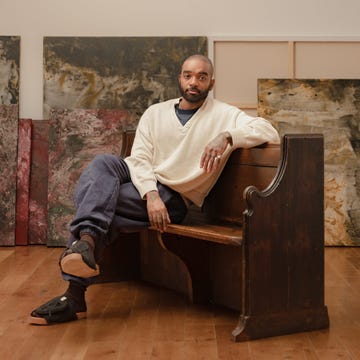
‘I think I’d probably be considered a bit of a heathen by a lot of blacksmiths,’ says Lewis (pictured top), a 29-year-old, self-taught blacksmith based in south London. He makes sculptural furniture and decor using forged steel in intriguing forms: a floor lamp made from a giant chain that seems to float; a spiky chair resembling a fish bone; a table with legs that look like spines.
Lewis studied furniture design at London Metropolitan University, and was working predominantly in carpentry when he began to explore metalwork. Excited by the ability to heat and bend metal, he bought a forge and started making – or, as he describes it, ‘messing about’. Now, he operates from a kitted-out workshop in Bermondsey, though he concedes it’s ‘difficult to find space in London’.

Forging steel offers him a medium that invites experimentation. ‘It’s the most free material I’ve ever experienced,’ he says. ‘There’s almost no limitations.’ Seeing the transition between solid and liquid captivates him, as does the ‘flow’ of the process – waiting for the forge to heat up, then quickly working the piece while it’s hot. Results can be unpredictable, but that’s something Lewis embraces.
Any downsides? ‘You always burn yourself. There’s no two ways about it – it’s really hard work.’ Lewis predominantly makes furniture, even though the pieces might err more on the side of sculpture than function. ‘It’s the right size for me to work with – the household scale,’ he says. ‘You can get a nice amount of decoration.’ While the forged metal has an inherent weightiness, Lewis explains he is drawn to delicate forms, something that becomes clear when you study the details of his pieces. Of particular delight are the steel ‘ribbons’ with graceful bows that appear like light fabric, wrapped around table and chair legs. Lewis loves crafting bespoke pieces, but is now working on made-to-order products too. Meanwhile, his works have featured in exhibitions at esteemed galleries including Saatchi Yates and Max Radford in London. His ‘lifetime goal’, though, is to get into the permanent collection of the V&A. Watch this space. @barnabymakes
Bertille Laguet

Working from a forge outside the Swiss village of Puidoux near Lake Geneva, Laguet harnesses her blacksmithing skills to make traditionally inspired, decorative shop signs and building elements, as well as artistic sculptures. ‘I like drawing inspiration from nature,’ she says. ‘It’s always been a subject in ironwork as well as in art. The world we live in today, and the fragile balance with natural resources and biodiversity, makes me want to make nature visible.’
What's everyone reading?
Her forged signs feature fruit, birds and flowers, and a steel sculpture created for the 2024 Homo Faber craft biennial depicts a decorative collection of plants and animals. But she dabbles in the abstract, too. ‘Seloncourt’, a series of wall-mounted forged-metal shapes, resembles linear pictograms. ‘It’s a kind of alphabet of symbols that could seem to come from the depths of time – from the moment when we first began making fire and forging metal,’ Laguet says. For her, each symbol actually expresses a memory she shared with her late grandmother.


The 37-year-old first studied industrial design at the Ecole cantonale d’art de Lausanne, but went on to train in wrought-iron artistry after meeting a blacksmith at a local forge and watching him work. ‘I asked if I could try it. After that, I came every Friday for a year to work with him, learning and helping,’ she says. When the blacksmith announced his plans to retire, she knew she needed to run it herself. ‘I realised that the fire had taken hold of me, and I couldn’t imagine my life away from the forge.’
She discovered that life as a blacksmith has a different feel to being an industrial designer. ‘I had the satisfaction of creating something by hand during my day, and installing it in people’s homes. I was also keeping control of the entire creative process, while earning a better living and giving my work more meaning.’ As a blacksmith, she loves ‘the sound of the anvil, the smell of coal, the heat, those moments of waiting for the metal to become hot and then thinking of nothing else but striking accurately with the right force in the right place’. With the metal so malleable, she says, ‘almost anything feels possible’. bertillelaguet.ch
Isabella Busoni

When Busoni, 31, realised she wanted to get into blacksmithing, she didn’t know where to start. The Londoner had studied metal fabrication during her performance-design degree at Central Saint Martins, but wasn’t sold on welding as a method. She read about blacksmithing and decided to try it out. ‘But, living in the capital, you don’t know any blacksmiths,’ she says. ‘It’s not a normal thing.’ After a social-media callout, she was connected to a friend’s mother who worked at the King Alfred School in north London, which has its own forge. That is where Busoni learnt the craft as an apprentice.
Eight years on, she now runs that forge, teaching blacksmithing to children. She loves the ‘whole process’ of the craft, describing it as ‘the dance between the fire and the anvil’, and her work blends inspirations of nature and folklore into objects for the home: candlesticks that curl like wisps of smoke; artful coat hooks; sculptural fire-pokers; even silhouettes of little demons and sprites. She loves making things that sit on the mantelpiece and become ‘part of people’s lives’.

Many of Busoni’s students have ‘really latched on’ to the art of blacksmithing – particularly the girls, she says. ‘It’s very much a tradition passed down through masters and apprentices and, normally, that would be a male-dominated lineage,’ she adds, pleased to be part of the change. Though it is hard work, Busoni insists she’s doing something she enjoys ‘more than anything in the world’. And she sees her craft becoming ever more popular. ‘As we’re shifting into this terrifying AI world, people are desperate to work on something tangible.’ isabellabusoni.com
Cameron Pearson

Pearson, a 23-year-old blacksmith, creates elegant sculptures in steel. Last year, those works won him the New Designer of the Year award, presented at the UK’s New Designers fair. It was a ‘shock’, he says, but it has been ‘absolutely amazing’ to know that his work is resonating. Pearson grew up near Hereford, where he still lives – a part of the country with a rich history of blacksmithing. The seeds of his interest were sown at his secondary school, which had a forge. When students tried out various trades for an industry day, Pearson chose this ancient craft. That experience convinced him to study it seriously: first at the National School of Blacksmithing, then at Hereford College of Arts, where he completed a BA in Artist Blacksmithing before undertaking an MA in Forged Metal Arts. Established last year, the MA is the first of its kind in the UK and one of a only handful of Master’s-level degrees in forging in the world. ‘It’s very exciting,’ Pearson says. Having learnt the technical skills, he is now able to find his ‘own identity’ as a blacksmith.

Pearson is drawn more to the artistic than the functional. While geometry was his initial driving inspiration – in part informed by a visit to Hereford Cathedral with its gothic architecture – he is evolving his language. What started as a mathematical study of form has become an exploration of how objects produce ‘aesthetic pleasure’. Though his works remain small in scale – which he likes for achieving a sense of handheld, intimate engagement – he dreams of making something larger one day. Pearson finishes his MA next year, and wants to open his own workshop. ‘I’ve got all the kit,’ he says. ‘Now I’m in search of a place to put it.’ @cameron_p_blacksmithing
Agnieszka Owsiany

Candelabras, candlesticks, mirrors – Owsiany’s work appears almost timeless; at once reminiscent of medieval decor and perfectly suited to contemporary interiors. While myriad young designers have been preoccupied with sharp stainless steel and aluminium, the 35-year-old’s forged-iron and steel designs take the trend for metal into a more elegant realm. And, having exhibited at events including Collectible and Milan design week, hers is an aesthetic making an impact. To create these pieces, the Polish designer works with a classically trained blacksmith, Andreas Billert. ‘There’s a real sense of collaboration,’ she explains. ‘He’s not just a fabricator who executes my drawings. We spend time in the forge and work together.’ Thus, Owsiany’s work demonstrates the potential for blacksmithing to be a core part of a designer’s language while honouring and celebrating existing craft expertise.
Based in the city of Poznań, Owsiany developed an interest in blacksmithing through a desire to engage with her Polish cultural heritage and traditional regional crafts. ‘I really saw the potential in blacksmithing,’ she recalls, and she was fascinated by how the technique ‘could be translated into a more modern language’.

Owsiany realised that exploring new forms – such as her characterful, asymmetrical candlesticks – would mean the craft could be revived. She sought out a trained collaborator with deep knowledge of the craft and found Billert. They have been working together for a year now. He is one of ‘only a few blacksmiths left in Poland working with these very traditional techniques’, she says. Learning by observing Billert, she now sometimes helps him in the forge, recently making a metal room-divider by herself, combining hand-forged-steel bars with abstract hammered-copper panels. She may make more solo pieces, but working alone isn’t the end goal. ‘It’s very important for me that I collaborate with someone who is truly exceptional in their field.’ agnieszkaowsiany.com